
Partner Management

B2B Partnerships 101: 15 Strategies for Success in 2026

As B2B partnerships become increasingly important to SaaS brands, how can you build a modern ecosystem to fuel growth while cutting CAC? Read on to find out.

5 min. read
09 Oct 2025
⚡ TL;DR

Our 15 steps for B2B partnership success in 2026 are:

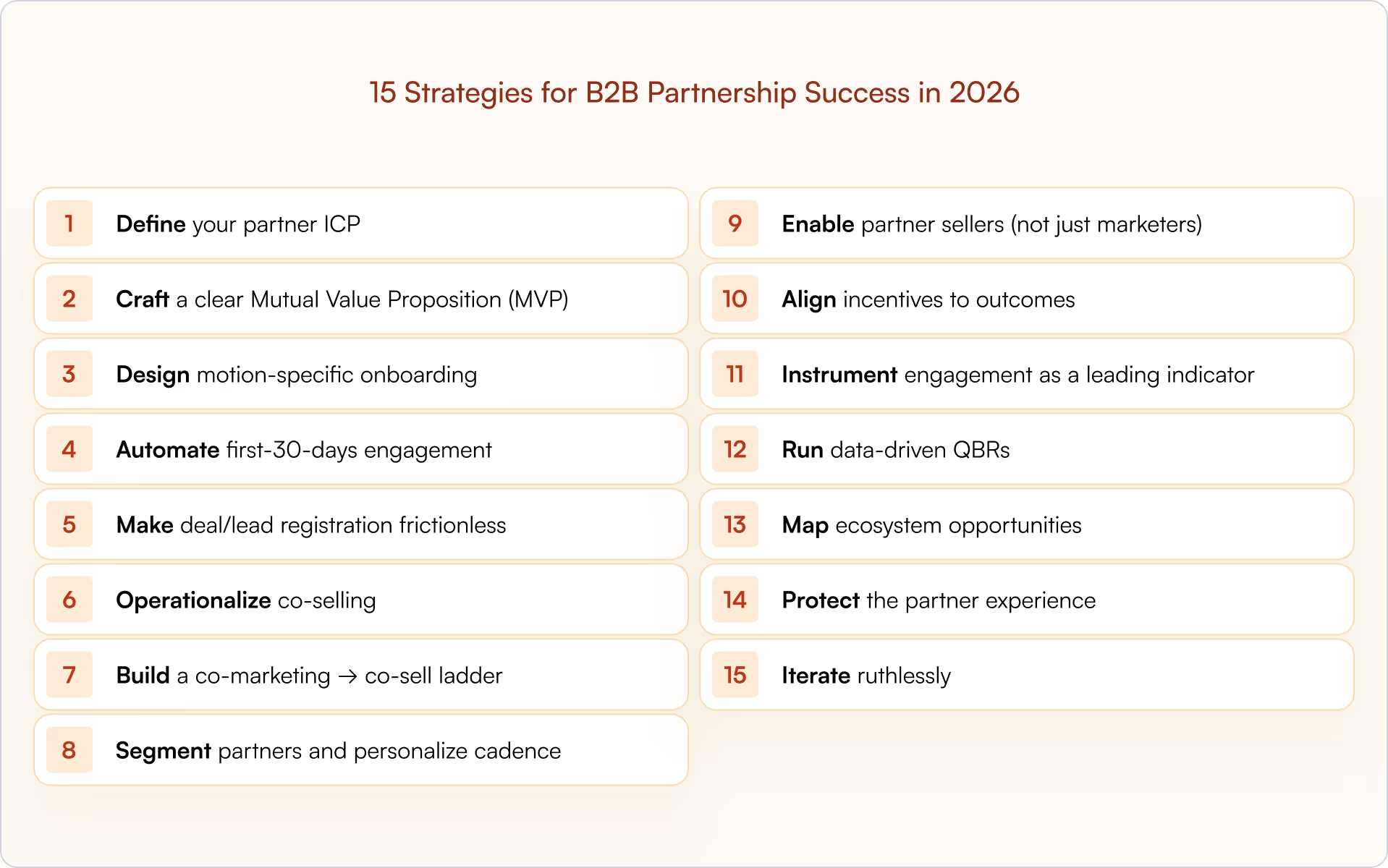
Define your partner ICP. Craft a clear mutual value proposition. Design motion-specific onboarding. Automate first-30-days engagement. Make deal registration frictionless. Operationalize co-selling. Build a co-marketing → co-sell ladder. Segment partners and personalize cadence. Enable partner sellers (not just marketers). Align incentives to outcomes. Instrument engagement as a leading indicator. Run data-driven QBRs. Map ecosystem opportunities. Protect the partner experience. Iterate ruthlessly.

In 2026, B2B partnerships will be more crucial than ever as SaaS brands strive for robust business growth while reducing costs.

As SaaS companies have increasingly relied on partnerships over the past few years, their strategies have evolved, transforming basic ad hoc collaborations into complex ecosystems made up of complementary products and services.

So what exactly do B2B partnerships in SaaS look like today? And how can you ensure they have maximum impact? 

Read on for our 15 strategies for SaaS partnership success in 2026. 

What Are B2B Partnerships? 

At their core, B2B partnerships are collaborative, revenue-oriented relationships between different businesses. 

Generally, these partner companies will operate in different but complementary spaces, and they may team up for a specific function, such as distribution, marketing, product/tech, or services. 

B2B partnerships are a particularly popular option in the SaaS sector, as they help software companies expand their pipelines, increase product value through integrations and bundled offerings, lower CAC by leveraging partners’ reach, and close deals faster. 

An important distinction to understand is the difference between B2B partnerships, channel partnership programs, and ecosystems. 

Bear in mind that, although each of the three models below is distinct, there is significant overlap. 

  • A B2B partnership is any collaborative relationship formed to drive shared revenue or value.
  • A channel partner program is a formal, structured way of managing and scaling B2B partnerships. Often, these use tiers, incentives, and certifications.
  • An ecosystem is a broad network involving many different partners in various disciplines. All these partners work together to create value for customers. 

Why B2B Partnerships Will Matter More Than Ever in 2026

In 2026, partnerships are a growth engine, not a side channel.

With budgets under pressure, SaaS businesses are increasingly relying on their partnerships to drive growth while simultaneously reducing their spending.

Furthermore, buyers now expect more than stand-alone products. They want integrations, services, and bundled solutions that address larger problems – all of which can be delivered through partnerships. 

Meanwhile, go-to-market has shifted toward ecosystem-led growth, where companies move with partners from co-marketing to co-sell to co-success, driving not just new business but retention and expansion. 

And because the CRM is the system of record, attribution must live there, or partner impact goes unmeasured. 

Types & Models of B2B Partnerships 

So let’s take a look at the different types of B2B partnerships you’re likely to see in 2026. 

  • Marketing partnerships, including co-marketing, content creation, webinars, events, and lead generation swaps.
  • Distribution partnerships, like reseller, VAR, MSP, referral, and marketplaces. 
  • Product/Tech partnerships, including integrations, ISVs, OEMs, and solution bundles.
  • Services/SIs/Agencies, such as implementation, migration, and vertical packages.

There are also different ways to structure partner relationships. 
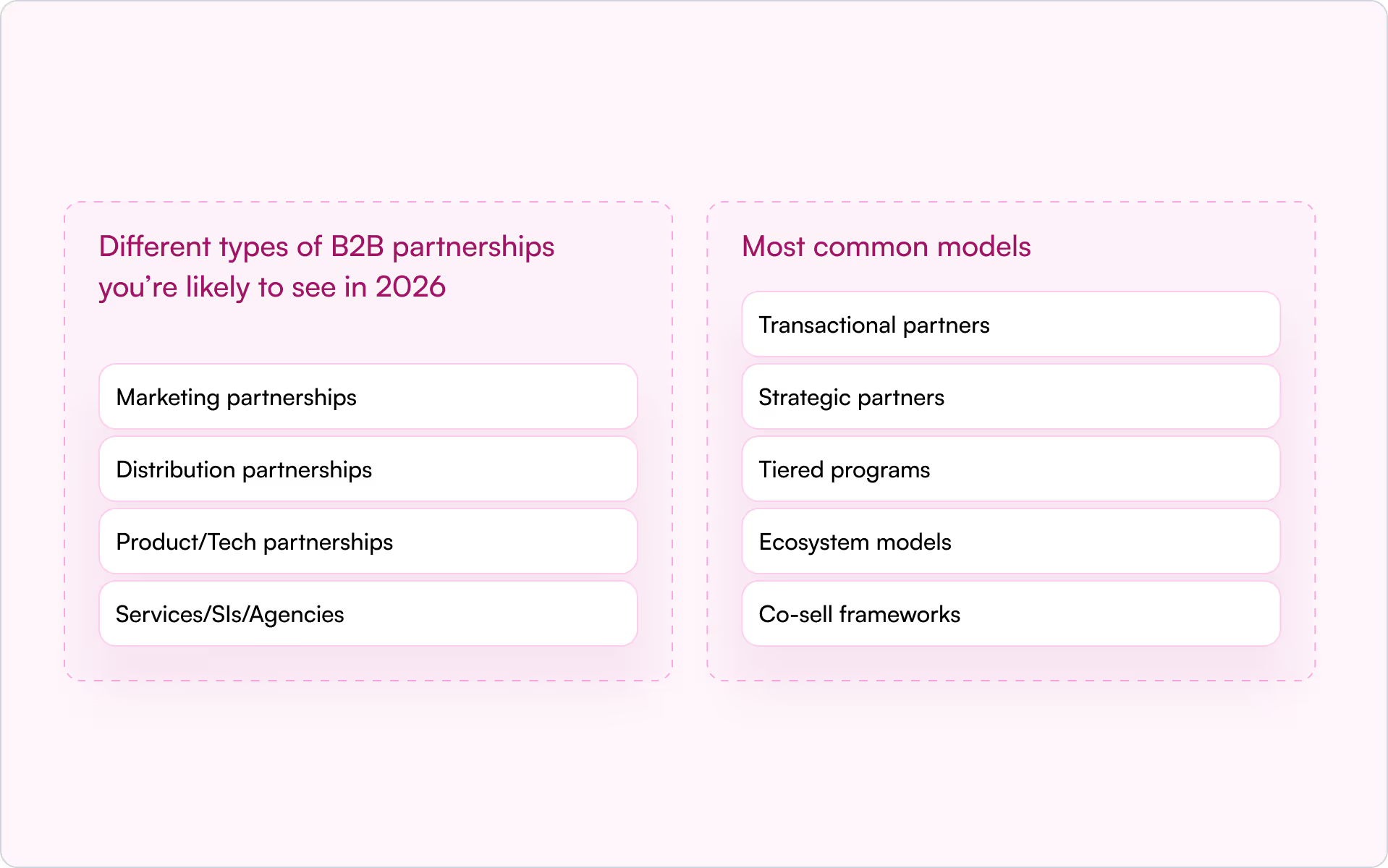
Here are some of the most common models:

  • Transactional partners bring in occasional leads or deals
  • Strategic partners are more aligned with shared goals, engage in joint planning, and make long-term commitments. 
  • Tiered programs reward partners based on volume or certification
  • Ecosystem models focus on collaboration across numerous partner types
  • Co-sell frameworks see direct collaboration between AEs from both companies to close deals together

For example, you might have an integration and reseller bundle that combines a SaaS integration with a reseller offering it as a packaged deal. 

An SI package for a vertical could look like a systems integrator designing a tailored solution, which includes your product, for an industry like healthcare or finance.

Or perhaps you’ll develop a co-marketing → co-sell funnel? You can build this by running joint marketing campaigns with your partners and then moving qualified leads into joint sales motions in order to close. 

15 Strategies for B2B Partnership Success in 2026

Is it time to elevate your SaaS partnership program to the next level? 

Here are 15 B2B partnership strategies for success in 2026. 
1. Define Your Partner ICP

Ready to find your ideal partner?

Just like you build an Ideal Customer Profile when you start your business, partnership success kicks off with a clear partner ICP. 

This should help establish a clear B2B partnership strategy, identify potential partners to prioritise, and avoid chasing ‘logo value’ over the actual revenue impact each partner could offer. 

Actions

Begin by identifying which partner characteristics most closely align with your product and target customers. 

Consider the following. 

  • Which industries do they operate in? 
  • What kind of deal sizes are they working with?
  • Where are they geographically? 
  • Do you have any tech stack overlaps?

Then, build a partner fit score that prioritises ensuring you share a very similar ICP, as well as market reach, and how complementary your SaaS products are. 

How Can Introw Help? 

Use partner relationship management (PRM) platform Introw to segment partners and automate scoring based on their performance and engagement.

2. Craft a Clear Mutual Value Proposition (MVP)

What problem do you solve together? Why now? Why you two?

Every strong partnership revolves around a shared story of why the partners have better outcomes together. 

Having this clarity makes it easier to align sales teams and resonate with customers.

Actions

When considering a new partnership, start by defining your joint problem.

Why are you best positioned to overcome this when working together?

Why is this an urgent problem that needs to be solved now?

Why is your combined approach to solving this problem unique?

Use your answers to craft a concise one-pager that lays out your MVP and includes ROI proof. 

Finally, develop a joint demo narrative that showcases your solution in action. 

How Can Introw Help? 

With Introw, teams can keep their co-sell playbooks all in one centralized location.

This makes it much easier to track which content partners are actually using (and using successfully) to drive deals. 

3. Design Motion-Specific Onboarding

Not all B2B SaaS partnerships operate in the same way. 

Referral, reseller, and integration partnerships, for example, each have their own unique roles and requirements. 

This is why it’s vital to avoid taking a one-size-fits-all approach. 

Actions

Instead, design motion-specific onboarding programs, complete with tailored templates, 30-60-90 day enablement plans, customized training, and clear first-deal targets to guide partners toward success. 

This ensures partners know what success looks like for them and have realistic goals to work towards, helping them ramp up more quickly. 

How Can Introw Help? 

Tailoring your onboarding program to each partner may sound time-consuming, but with Introw, it doesn’t need to be.

Indeed, this sophisticated platform can automate onboarding flows, track completion, and manage certification progress. 

This empowers your team to scale partner enablement efficiently, while maintaining high-quality engagement across various partnership types through tailored programs.  

4. Automate First-30-Days Engagement

The first month of a partnership is absolutely crucial. 

After all, partners who take early action are far more likely to deliver long-term value: you can look at speed-to-first-activity as an indicator of lifetime value. 

Actions

To accelerate speed-to-first-activity without the time-sink of manual admin, automate partner engagement to cover their first 30 days with you. 

Look at:

  • Automating welcome sequences
  • Drip key resources over time 
  • Send nudges (for example, “how to register your first deal”) to encourage and guide initial activity

How Can Introw Help? 

Introw helps by delivering updates via email or Slack without requiring a portal login, ensuring you can reach new partners where they’re at. 

The platform also provides engagement analytics, allowing teams to track who is active, identify stalled partners, and intervene at the first sign of disengagement. 

5. Make Deal/lead Registration Frictionless

Remove any barriers to deal registration – essentially make it as quick and easy as possible – and you should find that your partners log their deals more quickly and accurately, accelerating the sales cycle. 

Actions

The first step towards frictionless deal or lead registration is to avoid forcing portal logins. 

Instead, enable submissions via CRM, links, email, or Slack. 

This removes the potential barriers of forgotten passwords, 

When setting up your deal/lead registration forms, it’s vital to use standardized fields across all your platforms to ensure you’re capturing consistent data. 

You should also set up conflict rules to prevent overlapping data, and further smooth the partner journey with instant confirmations that submissions have been received. 

How Can Introw Help? 

Introw offers CRM-native deal/lead registration, which is crucial for this step. 

It automatically syncs information and sends notifications to both internal teams and partners. 

As outlined above, the platform also allows deal/lead reg links, email, or Slack. 

6. Operationalize Co-Selling

Structured collaboration between your team and your partners is crucial for effective co-selling. 

Set up a robust co-selling infrastructure, and you can ensure accountability, cut miscommunication, and synchronize both internal and partner teams. 

The result? 

The ability to close more joint deals more efficiently. 

Actions

To operationalize co-selling, work through the following points together:

  • Align on joint qualification criteria: The list of standards that your team and your partner use to determine whether a lead or opportunity is worth pursuing together.
  • Set service-level agreements: Outline your clear expectations for how quickly and reliably teams must share information around a deal.
  • Define Mutual Action Plans (MAPs): This shared roadmap should outline the key steps, responsibilities, and timelines required to close a deal.
  • Standardize stage definitions: If you’ve worked in more than one organization, you’ll likely be aware that sales cycle stages can be defined differently from sales team to sales team. Co-selling demands that you agree on what each stage of the sales process actually represents for both your internal team and your partner team.
  • Establish clear workflows between account executives: How will your internal sales team and your partner’s sales team collaborate on shared opportunities?
  • Establish a process for note sharing: Where will notes be stored? Who is responsible for taking them? Who will they be shared with? Can readers comment on notes and how? 
  • Meeting support: What exactly will the partners involved expect from each other in client meetings? Will you create joint demos or presentations, help to guide discussions, or simply attend to answer product or technical questions? 

How Can Introw Help? 

When it comes to co-selling, Introw provides a considerable boost. 

This software enables seamless coordination between your company and your partners by enabling shared updates visible to both teams, and tracking MAP milestones in real time. 

It also supports co-marketing efforts through a shared asset library, making it easy for both internal teams and partners to access the latest pitch decks, one-pagers, and campaigns — all auto-synced and accessible without needing to log into a portal.

7. Build a Co-Marketing → Co-Sell Ladder

B2B SaaS partnerships come into their own when they progress from shared visibility to shared revenue.

To turn this into a reality, you must construct an effective co-marketing → co-sell ladder. 

This ladder should start with co-marketing campaigns to build awareness, then nurture interest into MQLs, followed by warm partner-led introductions that convert into qualified opportunities, and finally, closed deals. 

Actions

Of course, this ladder must be carefully managed. 

First, you’ll need to create a shared campaign calendar to ensure all stakeholders are aware of their responsibilities and deadlines. 

Next, enforce UTM tracking, so you can see exactly which partner, campaign, or channel drove a lead or deal.

Finally, equip your SDRs with tailored enablement content.

How Can Introw Help?

With Introw, you can seamlessly manage co-marketing logistics such as campaign announcements.

The platform also makes tracking your co-marketing and co-sell activities easy, with visibility into partner-specific engagement like clicks and opens. Plus, you can centrally manage and distribute co-branded materials — including blog posts, one-pagers, and pitch decks — making it simple for partners to acc

8. Segment Partners and Personalize Cadence

In a true partner ecosystem, you’ll have some companies that contribute to your program daily, and others that just pop in as and when they have a lead for you. 

It’s important not to treat all of these partners in the same way for two reasons.

Firstly, treating every partner as if they contribute equally will dilute your results.

Furthermore, partners will respond best to tailored outreach cadence and bespoke engagement. 

Part of getting this right is about matching your partners’ maturity level within your scheme. 

Actions

Start by tiering partners based on their potential (for example, market fit, shared ICP, deal size) and engagement (for example, their activity and responsiveness). 

Then, tailor your outreach cadence and messaging to speak to these tiers. 

For example, run a ‘Top 20%’ play for high-potential partners with frequent check-ins and co-selling support, while using re-engagement flows to revive dormant partners.

How Can Introw Help?

Not too long ago, personalization was an extremely time-consuming (but still necessary) practice. 

However, Introw makes personalization scalable, with dynamic partner segments and automated cadences per tier, ensuring every partner gets the right level of attention at the right time – and without all the tedious admin. 

9. Enable Partner Sellers (Not Just Marketers)

For your co-sell ecosystem to operate effectively, partner sales reps must be able to talk confidently about your joint solution. 

While marketers are generally well-briefed on the products they’re expected to build campaigns around, you must understand the importance of informed salespeople. 

Actions

Put all stakeholders – including partner AEs – on role-based learning paths, where they are given the exact materials they need to do their job. 

For example, you could provide partner sales reps with enablement materials like: 

  • Bite-sized talk tracks
  • Objection handling guides
  • Competitive intelligence 

Top tip: build out a ‘first-call win kit’, containing pitch scripts, battle cards, and mini demo flows. 

These kits aim to help AEs succeed immediately, helping them overcome any initial hesitation and motivating them to reach out to more prospects. 

How Can Introw Help?

Introw supports partner sales enablement through its content hub, where all your resources can live. 

You can also utilize its content usage analytics to identify which materials are most engaging to users. 

10. Align Incentives to Outcomes

When it comes to reward, successful partner programs go way beyond just deal commission.

Instead, they recognize the full range of contributions that drive revenue. 

This approach motivates partners to stay engaged across the entire lifecycle, not just at the point of closing deals.

Actions

Consider adding certification bonuses for trained sellers, SPIFFs for short-term performance pushes, and credit for both sourced and influenced deals. 

When it comes to incentives, transparency is key. 

Publish clear rules around your rewards and revisit them quarterly to ensure they continue to align with your business goals. 

How Can Introw Help?

By automatically capturing partner activity and revenue impact, Introw helps to ensure recognition and payouts are accurate and fair.  

11. Instrument Engagement as a Leading Indicator

Looking for an early indicator of partner success?

Take your focus off revenue for a second and look at engagement metrics instead. 

Actions

Track engagement metrics like:

  • Portal visits
  • Content downloads
  • Email/message opens
  • Email/message click-through rates
  • Email/message replies
  • Meeting attendance 

These metrics will show you which partners are actively leaning in. 

Now, convert your results into an engagement score.

Partner managers should use this score to decide which partners to prioritize (aka, which are most likely to deliver results?). 

How Can Introw Help? 

Use Introw to feed your engagement data into role-based dashboards in Salesforce or HubSpot.

12. Run Data-Driven QBRs

In 2026, your Quarterly Business Reviews (QBRs) should have moved beyond static slide decks to live CRM dashboards. 

This empowers you to put a strong focus on real, actionable insights, while making reviews more collaborative and, vitally, grounded in facts rather than anecdotes. 

Actions

Harness the power of live dashboards to analyze key metrics such as:

  • Win/loss ratios
  • Stage leakage
  • Deal velocity
  • Recommended next-best actions

13. Map Ecosystem Opportunities

To truly maximize the tangible benefits of your partnerships, it’s essential to connect with complementary players within the ecosystem. 

Consider how you can create complementary triads within your ecosystem. 

Your product + an Independent Software Vendor (ISV) + a systems integrator (SI) = bigger, stickier deals. 

Actions

To uncover the best triads, run overlap analyses on your customer bases to find out which partners share a similar audience.

Once you’ve identified your complementary trio, build packaged offers that combine all your strengths, and create reference architectures that show how all your solutions fit together. 

How Can Introw Help?

Introw lets you tag and add notes by partner type, making it easier to spot potential bundle plays. 

This transforms isolated partnerships into ecosystem-driven opportunities with a greater impact.

14. Protect the Partner Experience

A strong partner experience hinges on high levels of trust and smooth, easy interactions. 

Clear communication and fast responses are crucial to this. 

Actions

While establishing clear and quick communication may feel like an easy win, it’s vital to create a strong structure to avoid lapses in your strategy. 

There are three key components to a strong partner comms strategy:

  • Establish a response-time SLA
  • Lay out a defined escalation path for urgent issues
  • Develop a feedback loop to capture partner input continuously

How Can Introw Help?

Introw supports the partner experience by sending automated status updates and running NPS-style pulse checks.

15. Iterate Ruthlessly

To maximize the impact of your partner program, keep a laser-sharp focus on what is working and what is not. 

Be ruthless here: double down on the tactics that are producing results, and cut those that aren’t.

Actions

Here’s what this might look like:

  • Implement monthly performance reviews
  • Run A/B tests on content and campaigns
  • Pilot new tiers or programs to see what resonates
  • Sunset low-ROI motions
  • Double down on high-ROI partners and plays

How Can Introw Help?

Introw provides performance snapshots and trend alerts, helping users to spot both successes and drops in engagement quickly, and empowering them to switch up their strategy fast. 

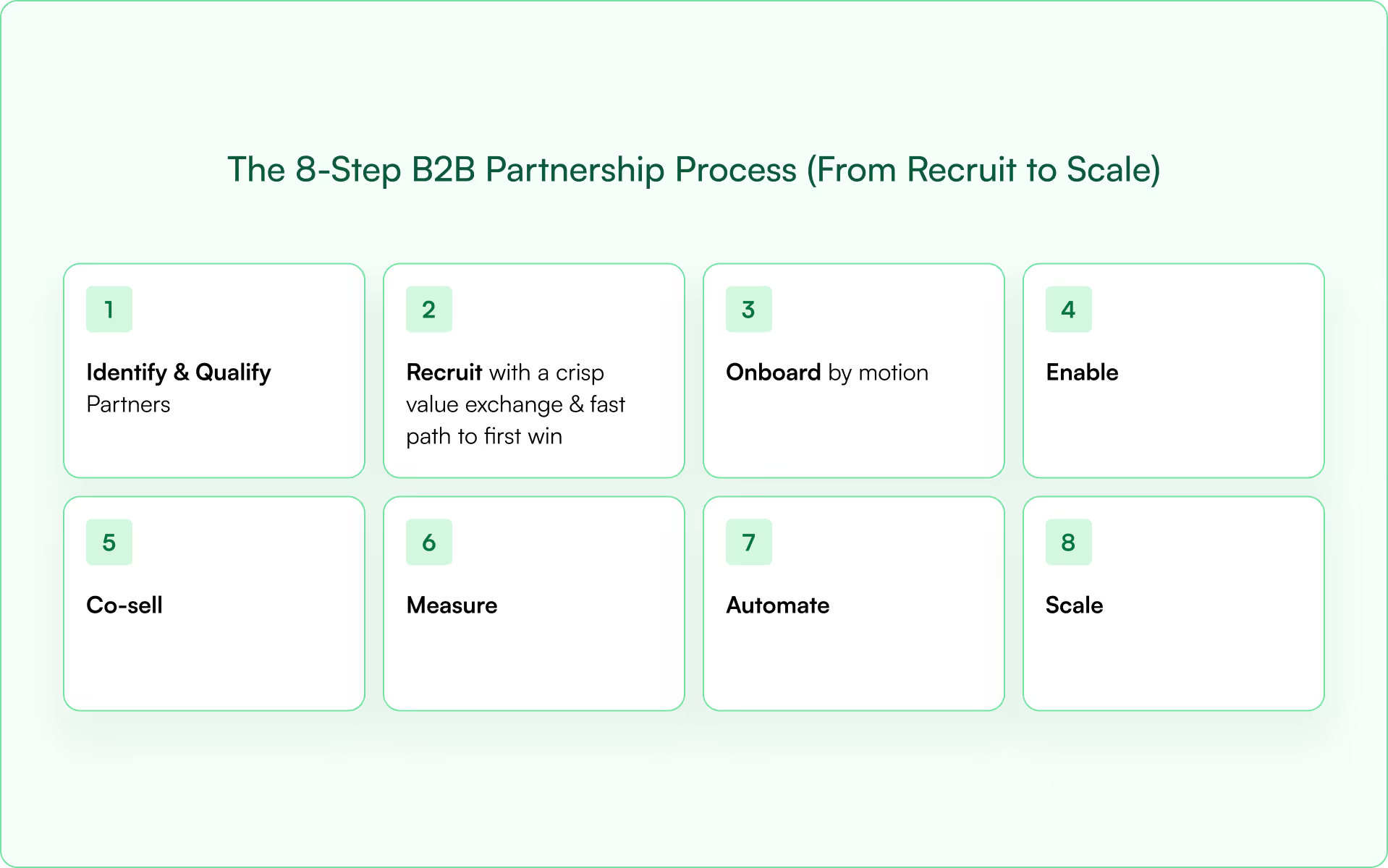
The 8-Step B2B Partnership Process (From Recruit to Scale)

Here are eight steps to take you from the recruitment stage of your partnership program to scaling. 
1. Identify & Qualify Partners 

Start by mapping potential partners against your ideal customer profile to assess their fit and intent.

Assess their market presence, technical compatibility, and willingness to actively engage with you.

This should ensure you focus on partners most likely to drive meaningful results.

2. Recruit With a Crisp Value Exchange & Fast Path To First Win

It’s crucial that you can clearly articulate what partners gain from working with you, from revenue opportunities to partner enablement resources

Furthermore, you must make it easy for your partners’ sales reps to achieve their first success quickly. 

After all, early wins build momentum and trust.

3. Onboard By Motion

Tailor the onboarding process to the type of partner you’re dealing with to facilitate different levels of responsibilities, knowledge, and engagement. 

Apply this personalized approach to:

  • SLAs
  • MAPs
  • Resources

4. Enable

Provide partners with ready-to-use marketing assets, including co-marketing kits and seller playbooks. 

Your partnership co-marketing kit could include:

  • Email templates and social posts
  • Landing pages or microsites
  • Decks, one-pagers, and case studies 
  • Logos and imagery 
  • Brand guidelines 

Meanwhile, your seller playbooks may contain vital info on objection handling, competitive intelligence, and talk tracks. 

5. Co-sell

It’s time to start selling! 

But first, define structured processes for collaborating on shared opportunities. 

These processes will need to take into account:

  • Deal registration
  • Handoffs
  • Stage updates
  • Conflict rules

6. Measure

The exact metrics you decide to track will depend on your company’s goals and specific circumstances. 

However, when measuring the success of partnership programs, it’s beneficial to track partnership metrics surrounding:

  • Engagement 
  • Pipeline 
  • Revenue 
  • CSAT/NPS

The resulting data should inform your decisions on where to invest, coach, or adjust your partnership strategies.

7. Review

Your QBRs will likely form the backbone of your review process. 

Use these to assess your performance against your business goals, analyse your wins and losses, adjust partner tiers or incentives as required, and identify any risks to your pipeline. 

And don’t forget to define next-best actions for both the vendor and the partner. 

8. Scale

Finally, it’s time to scale. 

Leverage successful B2B strategic partnerships to expand into new geographies or verticals, map opportunities for ecosystem bundles, and enact marketplace plays to increase visibility and adoption. 

Metrics & Scorecards That Actually Predict Success

As outlined above, the exact combination of metrics you track will depend on your specific circumstances and goals. 

However, when it comes to predicting success, there are a few leading and lagging indicators that are especially valuable. 

Leading indicators: 

  • Engagement score
  • Time-to-first activity
  • Enablement completion
  • Meeting acceptance

Lagging indicators: 

  • Sourced/influenced pipeline
  • Win rate
  • Deal velocity
  • ARR
  • Retention/expansion

Furthermore, here’s an example of the core categories you might want to include in a partner scorecard to track performance:

  • Partner fit
  • Activity
  • Pipeline
  • Revenue
  • Forecast
  • Confidence 

One of the best PRM platforms on the market, Introw makes tracking and analysing all this data much easier by providing users with a single source of truth, complete with CRM-native attribution and real-time dashboards. 

So, instead of juggling partner portals, spreadsheets, and CRM exports, users get easy access to unified, real-time data, all on one platform. 

Here’s what this looks like:

  • Single source of truth: All partner activities, from deal registration to co-selling notes, are captured in one location, so sales, marketing, and partner teams are all looking at the same information.
  • CRM-native attribution: Partner influence is automatically tied to pipeline and revenue inside your CRM, ensuring that deals are appropriately credited. 
  • Dashboards: Automated custom dashboards make it easy to run QBRs, track ROI, and make decisions around priorities and investments. 

Conclusion

B2B partnerships thrive when you reduce friction, personalize by motion, and measure in CRM. 

With a clear partner ICP, motion-specific playbooks, and CRM-first automation, you’ll turn partnerships into a repeatable revenue engine – fast.

➡️ Ready to operationalize B2B partnerships in your CRM? Request an Introw demo.

FAQs

Still curious? Here are some quick answers to help clear things up.

Contact us

What Is a B2B Partnership (In SaaS)?

When embarking on a B2B partnership, two or more businesses in SaaS collaborate to drive mutual growth. This means that instead of competing, the partner businesses will collaborate with each other for mutual benefit. This strategy enables them to enhance their offerings, expand their reach into new markets, and improve overall customer outcomes – all without a significant cash investment. There are several different types of SaaS partnerships out there. Here are three examples of B2B partnerships: In one scenario, you might have tech integrations, where two platforms connect to create a smoother user experience. Or perhaps you’ll enter into a reseller or B2B channel partnership, in which one company sells the other’s SaaS product. Alternatively, perhaps you’ll embark on a co-marketing partnership, where two or more companies run joint campaigns in a bid to attract new audiences. Ultimately, the goal is to combine your strengths – whether technical, commercial, or strategic – with those of your partner to boost the bottom line.

Which B2B Partnership Models Work Best In 2026?

The partnerships that work best for your brand in 2026 will ultimately depend on your circumstances and goals. However, with buyers becoming increasingly demanding, several types of partnership models are particularly useful this year. Ecosystem partnerships bring together a whole network of companies that contribute across various business functions, from implementation and customer success to feedback loops and innovation. Typically, compensation for ecosystem partnerships includes not only sales but also other desirable outcomes, such as retention, satisfaction, and adoption. Embedded and integration-first partnerships involve partners building their tool directly into the SaaS product, such as CRM-first partner portals like Introw. AI-powered partner ecosystem tools are also on the rise, helping to cut friction when scaling B2B partner programs. This technology can be harnessed for partner recruitment, matching partners to new customers, suggesting partner enablement content, automating performance tracking, and more. Vertical-specialist partner models occur when a group of companies that deeply understand one specific industry vertical team up. This approach boosts trust among potential customers and helps differentiate the ecosystem from less-specialised competitors. Finally, outcome-based partnerships align incentives so that both partners and vendors succeed only when genuine value is delivered to customers – for example, usage, adoption, and expansion, as well as the initial sale.

How Do I Measure Partner Impact Beyond ‘Sourced Pipeline’?

Need to find out whether partners are strengthening customer outcomes and long-term revenue, as well as generating leads? Then you’ll need to venture beyond ‘sourced pipeline’ metrics and look at how your B2B partners influence the entire customer lifecycle. Track metrics like: - Influenced pipeline (deals where partners shaped decisions) - Deal acceleration (shorter sales cycles) - Win rates (higher close ratios with partner involvement) - Adoption and usage growth - Retention rates - Expansion revenue - Net Promoter Score (NPS)

How Do I Scale From a Few Partners To An Ecosystem?

So you’re looking to take your partner program up a few notches? Or, in other words, transform a few ad-hoc joint ventures into a structured, scalable partner ecosystem? Here’s how: 1. Start by defining clear partner types, such as resellers, ISVs, integrators, and consultants 2. Create enablement resources covering onboarding, training, and certification 3. Invest in a partner portal like Introw, with self-service tools, deal registration, and a CRM-first setup. 4. Incentivize sourcing deals, adoption, retention, and expansion. 5. Encourage an ecosystem mindset, where partners join forces and collaborate with each other as well as your business. Get this right, and you should see your partners growing significant value beyond just one-to-one relationships.

How Does Introw Streamline Onboarding, Co-sell, and Attribution?

Let’s take this one step at a time. First up, how does Introw streamline onboarding? With Introw, you can automate partner onboarding flows via form submissions, which sync directly with your CRM (for example, HubSpot or Salesforce). New partner applications trigger workflows to assign tasks, send training materials, and set up partner profiles. When it comes to co-selling, partners can register new leads or deals through off-portal forms, email, or Slack, without needing to log in. Deal information is then automatically mapped to the CRM. Real-time embedded CRM cards empower internal teams and partners to collaborate efficiently on deals, track their progress, and share their updates without the need to switch tools. Finally, because everything from lead registration and deal closure to partner influence flows through the CRM, Introw automatically attributes which partner contributed to which deal. It also supports commission tracking and automated payout rules to ensure all parties involved are appropriately rewarded.


Launch your partner portal
in minutes!

Thank you! Your submission has been received!
Oops! Something went wrong while submitting the form.

Related blog articles

Partner Management

Best Partner Relationship Management (PRM) Software for B2B Teams in 2026

Andreas Geamanu
Co-founder & CEO
5 min. read
17 Mar 2026
⚡ TL;DR

Partner relationship management (PRM) software helps you manage partner relationships, run partner programs, and track deal registration without losing visibility in your customer relationship management system.

If you’re comparing PRM software, this guide shows what actually works and how to choose the right fit.

Most PRM platforms still rely on a partner portal, which can slow down partner onboarding, partner activities, and adoption. Newer platforms focus on real-time collaboration, cleaner partner data, and better partner communication.

That makes it easier to manage partner relationships across the entire partner lifecycle, support channel partners, and improve partner performance.

If you’re looking for a faster, CRM-first approach to partner relationship management, Introw is built to help your sales team move quicker and stay aligned.

The best partner relationship management software (shortlist)

If you’re comparing PRM software, you don’t need a long list. You need tools that help you manage partner relationships, support co-selling, and drive partner revenue without slowing your team down. If you’re still deciding what matters, reviewing PRM best practices and learning how to choose a PRM will help you make a better call.

1. Introw

Introw is an AI-first partner relationship management software built for SaaS teams that want a modern partner experience directly inside their customer relationship management system.

It replaces the partner portal with real collaboration across email and Slack, so your sales team and channel partners stay aligned on deal registration, deal progression, and partner activities.

For co-selling and indirect sales channels, it gives you clear visibility into partner performance, partner revenue, and the sales pipeline without duplicating partner data.

Introw also combines execution with AI, helping you automate partner onboarding, track partner activities in real time, and keep deals moving across the sales cycle with built-in insights and communication support.

Best for

  • SaaS teams scaling partner programs and partner networks
  • Teams that want to manage partner relationships without a partner portal
  • Businesses focused on co-selling and partner growth

How Introw approaches partner relationship management differently

Most partner relationship management tools are built around structure. They rely on partner portals, manual updates, and separate workflows for partners and sales teams.

That works for some channel programs. But it can slow things down, especially if your team is focused on co-selling and real collaboration across the partner journey.

Introw takes a different approach.

Built inside your CRM, not around it

Introw works directly inside your customer relationship management system, including native integrations with Salesforce and HubSpot.

Your partner relationship manager, sales team, internal teams, and channel partners all stay aligned on deal registration, deal progression, and partner activities in one place.

This makes it easier to manage partner relationships without duplicating data or switching between systems.

Collaboration without the portal friction

Instead of forcing partners into a portal, Introw supports collaboration through email, Slack, and shared workflows.

That means business partners can stay engaged without changing how they already work.

It also reduces delays. Conversations, updates, and deal progress all happen in real time, which is critical for co-selling and keeping momentum across your partnership strategy.

Visibility into what partners are actually doing

Because everything happens inside your CRM, you get a clearer view of partner performance, partner revenue, and pipeline.

You can see which partners are active, where deals are progressing, and where support is needed without chasing updates.

This level of visibility helps teams reduce channel conflict and balance partner motions with direct sales.

AI support that fits into your workflow

Introw combines execution with AI to reduce manual work.

With the Introw + Claude integration, your team can generate summaries, surface insights, and keep partner communication moving without extra tools.

If you want to get started, you can install the Claude connector directly into your workflow.

If your team is building toward world class partner programs with faster execution and stronger visibility, this approach can feel much simpler than traditional partner management software.

In the end, the difference comes down to how your team actually works with partners.

If you’re looking for a simpler way to manage partner relationships and improve partner engagement across the entire partner lifecycle, Introw is a strong option to consider.

2. Salesforce PRM

Salesforce PRM is a partner relationship management software built into the broader customer relationship management platform, so it’s a natural fit if your business already runs on Salesforce. It helps you manage partner relationships, track deal registration, monitor partner activities, and support channel partners within a single system.

It works well for large partner ecosystems with complex partner programs, but it often depends on partner portals and custom setup across the partner lifecycle. That can slow partner onboarding and make partner experience harder to manage without strong partner operations and clear relationship management processes.

Best for

  • Enterprise teams already using Salesforce
  • Complex partner programs and channel sales
  • Businesses with strong internal ops resources
Pros Cons
Deep integration with customer relationship management data Heavy setup and customization required
Strong deal registration and lead distribution workflows Relies on partner portal workflows
Advanced reporting on partner performance Slower time to value for smaller teams

When it may not be the right fit

If your team needs fast setup, flexible collaboration, or wants to avoid heavy customization and portal-based workflows, this approach can feel limiting

If you’re exploring alternatives, many teams compare Salesforce PRM alternatives to see how modern PRM software supports co-selling and partner experience.

3. Impartner

Impartner is a well-known partner relationship management software designed to support structured partner programs across large partner networks. It focuses on partner onboarding, partner portals, and managing the partner lifecycle at scale.

It’s often used by companies with established reseller programs and formal partner operations. That said, it can feel heavy if your team wants faster setup or more flexible co selling workflows.

Best for

  • Mid-market to enterprise partner programs
  • Teams running structured reseller partners and referral partners
  • Businesses focused on long-term partner lifecycle management
Pros Cons
Strong partner onboarding experience Portal-heavy experience
Built-in marketing tools and co marketing support Less flexible for co-selling workflows
Detailed tracking of partner performance and partner activities Can feel complex for smaller teams

When it may not be the right fit

If your team prioritizes speed, simplicity, or real-time collaboration over structured partner programs, this setup can feel heavy and slow to adapt.

If you’re comparing tools in this category, reviewing the best Impartner competitors can help you see how newer PRM platforms approach partner management.

4. ZINFI

ZINFI is a partner relationship management software focused on channel partners, partner recruitment, and managing global partner ecosystems. It combines partner management, marketing activities, and sales enablement into one platform designed for indirect sales.

It’s a solid option for companies that need to manage reseller programs across regions, but the experience often centers around partner portals and structured workflows across the partner lifecycle.

Best for

  • Global partner ecosystems and channel sales teams
  • Businesses managing reseller programs at scale
  • Teams focused on partner recruitment and partner performance
Pros Cons
Strong support for partner onboarding and the partner lifecycle Relies on structured partner portal workflows
Tools for marketing campaigns and co-marketing Less flexible for fast-moving sales teams
Built-in performance metrics and reporting capabilities Can feel rigid for modern partner ecosystems

When it may not be the right fit

If your team needs flexible collaboration, faster execution, or wants to reduce reliance on partner portals, this approach may feel too rigid.

5. Magentrix

Magentrix is a partner relationship management software focused on customizable partner portals and controlled access to partner resources. It helps teams manage partner relationships, share marketing materials, and track deal registration and partner activities across the partner lifecycle.

It’s often chosen by teams that want flexibility without building a system from scratch, though most workflows still run through the partner portal.

Best for

  • Teams that want customizable partner portals
  • Businesses managing partner networks with structured access
  • Companies sharing marketing materials and partner resources
Pros Cons
Flexible partner portal setup with controlled access Portal-first experience
Integration with customer relationship management systems Less focus on real-time collaboration
Tools for managing partner activities and deal progression Can require setup to fit workflows

When it may not be the right fit

If your team prioritizes real-time collaboration, faster execution, or wants to reduce reliance on a partner portal, this setup may feel limiting.

6. Mindmatrix

Mindmatrix is a partner relationship management software that combines partner management, marketing automation, and partner enablement into one platform. It helps teams onboard partners, manage partner activities, and run marketing activities across the partner lifecycle.

It’s often used by companies that want to support partners beyond deal registration, especially with content, campaigns, and ongoing engagement.

Best for

  • Teams focused on partner onboarding and partner enablement
  • Businesses running content-driven partner programs
  • Companies supporting partners across the entire partner lifecycle
Pros Cons
Combines partner management with marketing automation Can feel complex to set up
Strong support for partner onboarding and partner training The interface can feel dated
Supports marketing activities and co-marketing campaigns Less focused on CRM-native workflows

When it may not be the right fit

If your team wants a lightweight tool or primarily needs CRM-native collaboration, this platform may feel too complex.

7. PartnerStack

PartnerStack is partner relationship management software built for SaaS companies running affiliate, referral, and reseller partner programs. It focuses on partner recruitment, incentive programs, and scaling partner networks.

It’s widely used for SaaS growth through partnerships, especially in marketing-led and indirect sales models.

Best for

  • SaaS companies running affiliate or referral partner programs
  • Teams focused on partner recruitment and partner growth
  • Businesses scaling partner ecosystems quickly
Pros Cons
Strong partner recruitment and partner discovery capabilities Less suited for complex B2B co selling
Automated payouts and incentive management Limited visibility into partner performance
Easy to scale partner programs quickly Not built for deep sales collaboration

When it may not be the right fit

If your focus is on complex sales processes, co-selling, or managing enterprise channel partners, this platform may not provide enough depth.

8. Crossbeam

Crossbeam is a partner ecosystem platform focused on account mapping, partner data sharing, and identifying opportunities across your partner network. It helps teams uncover overlap, support co-selling, and improve partner collaboration through shared insights.

It’s often used alongside partner relationship management software rather than as a full partner management solution.

Best for

  • Teams focused on co-selling and account mapping
  • Businesses running ecosystem-led growth strategies
  • Sales teams identifying shared opportunities with channel partners
Pros Cons
Strong partner data visibility and account mapping Not a full partner management software
Helps identify co-selling opportunities quickly No deal registration or partner onboarding workflows
Integrates with customer relationship management systems Requires additional tools for execution

When it may not be the right fit

If you need complete partner relationship management software to manage the entire partner lifecycle, this platform will need to be paired with other tools.

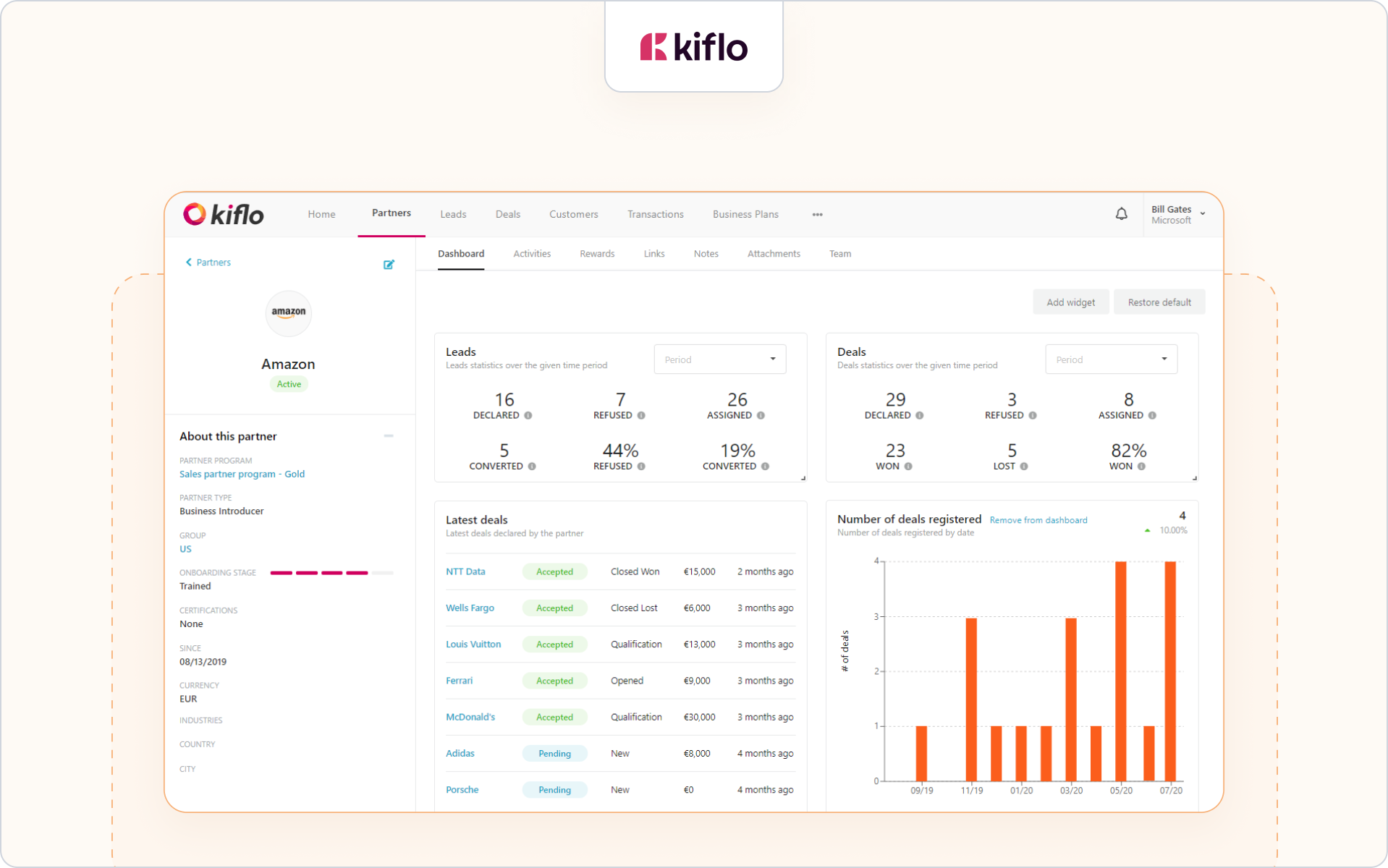
9. Kiflo PRM

Kiflo PRM is a lightweight partner relationship management software designed for small to mid-sized SaaS companies. It focuses on simplicity, helping teams manage partner onboarding, deal registration, and partner activities without heavy setup.

It’s positioned as an accessible option for teams building or scaling partner programs.

Best for

  • Small to mid-sized SaaS companies
  • Teams starting or growing partner programs
  • Businesses looking for simple partner management tools

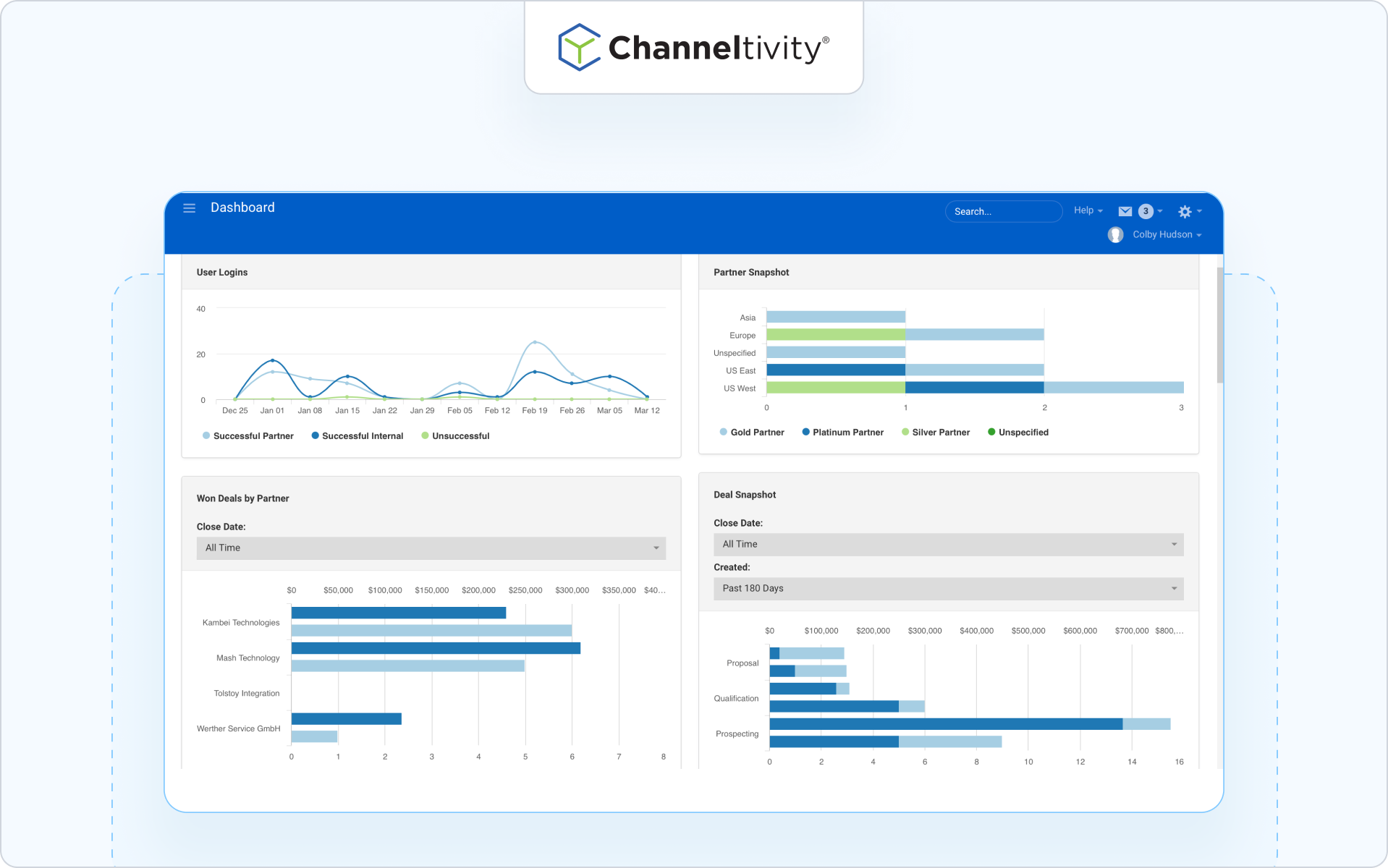
10. Channeltivity

Channeltivity is a partner relationship management software focused on deal registration, partner communication, and performance tracking. It provides structured workflows through a partner portal to manage partner relationships and partner activities.

It’s often used by mid-market companies that want clear processes and visibility without enterprise-level complexity.

Best for

  • Mid-market B2B companies
  • Teams focused on deal registration and partner performance
  • Businesses managing structured partner programs
Pros Cons
Clear deal registration and lead distribution workflows Portal-based collaboration model
Centralized partner communication tools Limited flexibility for co-selling
Reporting dashboards for partner performance Less focus on real-time collaboration

When it may not be the right fit

If your team wants flexible collaboration or to move away from partner portal workflows, this setup may feel restrictive.

11. ChannelScaler

ChannelScaler is a partner relationship management software designed to help SaaS companies scale indirect sales and improve partner performance through better visibility and performance tracking.

It focuses on helping teams understand partner contribution to channel revenue, prioritize high-performing partners, and improve decision-making across their partner network.

Best for

  • SaaS companies scaling indirect sales channels
  • Teams focused on partner performance and channel revenue
  • Businesses needing better visibility into partner data
Pros Cons
Strong visibility into partner performance and sales pipeline Less focus on partner onboarding and enablement
Helps prioritize high-performing partners Not built for complex partner ecosystems
Focus on performance tracking and reporting capabilities Limited real-time collaboration features

When it may not be the right fit

If your team needs strong partner onboarding, enablement, or day-to-day collaboration features, this platform may not cover all needs.

PRM software: A side-by-side comparison

Tool Best for Key strengths Limitations
Introw SaaS teams prioritizing co-selling and CRM-native workflows CRM-first approach, real-time collaboration, fast time to value, no heavy portal reliance Newer platform compared to legacy tools
Salesforce PRM Enterprise teams already using Salesforce Deep CRM integration, advanced reporting, strong deal registration workflows Heavy setup, portal-based workflows, slower time to value
Impartner Structured partner programs at scale Strong partner onboarding, marketing tools, lifecycle management Portal-heavy, less flexible for co selling
ZINFI Global partner ecosystems and channel sales Partner recruitment, lifecycle management, marketing, and enablement tools Rigid workflows, portal-centric experience
Magentrix Customizable partner portals Flexible portal setup, controlled access, CRM integrations Portal-first experience, limited real-time collaboration
Mindmatrix Partner enablement and marketing-driven programs Combines partner management and marketing automation, strong onboarding support Complex setup, less CRM-native collaboration
PartnerStack SaaS affiliate and referral programs Partner recruitment, automated payouts, easy scaling Limited for B2B co selling and complex sales workflows
Crossbeam Ecosystem-led growth and account mapping Partner data sharing, account mapping, co selling insights Not a full partner management solution
Kiflo Small to mid-sized SaaS teams Easy setup, simple workflows, lightweight tool Limited scalability and advanced features
Channeltivity Mid-market teams with structured workflows Clear deal registration, partner communication, and reporting Portal-based, less flexible collaboration
ChannelScaler Indirect sales performance tracking Strong partner performance visibility, revenue tracking Limited onboarding and collaboration features

We know there were plenty of options. And of course they don’t all solve the same problem.

Some are built for structured partner programs. Others focus on co-selling, partner engagement, or ecosystem visibility.

The right choice depends on how your team works today and where you want to take your partner strategy next.

Let’s look at how to evaluate these tools in a way that actually supports your goals.

How to evaluate partner engagement tools: 5 key questions

Choosing partner engagement tools isn’t about features. It’s about how well the platform supports your partner program and how your sales team works with partners day to day.

A quick way to assess this is to pressure-test how the tool supports the partner lifecycle. Many teams start by reviewing a broader partner lifecycle management strategy to see where tools need to support execution.

Here are five key questions to ask:

1. Does it match how your partners actually sell?

Start with your partner model.

If you’re running structured channel partner programs alongside direct sales, you may need tighter workflows. If you’re focused on co-selling, flexibility matters more.

Many teams choose partner relationship management software that looks powerful but doesn’t match how their sales team actually works.

2. Where does collaboration actually happen?

Some tools rely on a partner portal. Others support collaboration through email, Slack, and shared workflows.

Portals can create structure, but they also add friction. If partners don’t log in regularly, deal registration slows down.

The easier it is to work together, the easier it is to keep partners engaged.

3. Can you clearly see partner performance?

You should be able to track partner performance, pipeline, and revenue without digging through reports.

Strong visibility helps you understand what’s working and where deals are stuck. It also makes it easier to manage both partner and direct sales motions.

4. Does it help you enable partners or just track them?

There’s a big difference between managing partners and enabling them.

Strong tools support partner onboarding, share the right resources, and help partners move deals forward.

If your tool only tracks activity, it’s not doing enough.

5. How quickly will it deliver value?

Some tools take months to implement. Others start working in weeks.

If setup is slow, adoption drops. The best tools reduce manual work and help your team start supporting partners quickly.

This is where the gap between traditional PRM software and newer approaches starts to show. But how can you close that gap?

Final thoughts

The best partner relationship management tools don’t just help you manage partners. They help you build active partners, improve partner satisfaction, and drive consistent partner revenue.

Some platforms prioritize structure and control. Others focus on speed, collaboration, and visibility across your partner ecosystem.

The right software solution comes down to how your team works and what your partnership strategy needs to support.

Next steps

  1. Review your current setup and identify where partner engagement slows down
  2. Look at how easily your team can register deals and manage lead management across partners
  3. Prioritize platforms that help you enable partners, not just manage them

If you’re exploring a more flexible, CRM-native approach to partner management, book a demo to see how Introw works in practice.

Partner Management

From Strategy to Results: 11 Partner Enablement Best Practices That Work in 2026

Sara De Meurichy
Growth
5 min. read
14 Mar 2026
⚡ TL;DR

Partner enablement gives partners the training, content, tools, and support they need to sell independently rather than relying on constant hand-holding from your team. The most effective programmes are structured, segmented by partner type, and connected to the CRM so you can measure readiness, track activation, and attribute revenue accurately. Strong enablement focuses on reducing time to first deal, delivering role-based training, and giving partners collateral they will actually use in live opportunities. To understand whether the programme is working, teams should track outcome-based metrics such as pipeline, revenue, certifications, and activation speed rather than vanity portal activity.

Partner enablement looks simple on paper: give partners the right resources, and they’ll sell your product. In practice, most programs stall because content is scattered, training is generic, and no one can tell which partners are actually ready to close deals.

The difference between a partner program that generates attributable revenue and one that drains resources usually comes down to structure — clear goals, the right content at the right time, and data that lives in your CRM instead of a forgotten portal. This guide breaks down partner enablement best practices from strategy through execution, plus the metrics that tell you if it’s working.

What is partner enablement?

Partner enablement is the system you build to help external partners sell (and often implement) your product effectively. That system typically includes structured onboarding, tailored training, and easy access to the right resources so partners can move deals forward without waiting on your team.

When partner enablement is done well, partners don’t just understand what you do. They can position it, handle objections, run a clean handoff, and create repeatable wins — the same way a high-performing internal sales team would.

What partner enablement typically includes

  • Training and certification: Product knowledge, positioning, and selling motions (with a quality bar partners must meet).
  • Sales and marketing resources: Collateral, templates, and campaigns partners can use with prospects.
  • Tools and portal access: Systems that streamline deal registration, content access, and communication.
  • Ongoing communication: A predictable cadence for updates, feedback, and performance reviews.

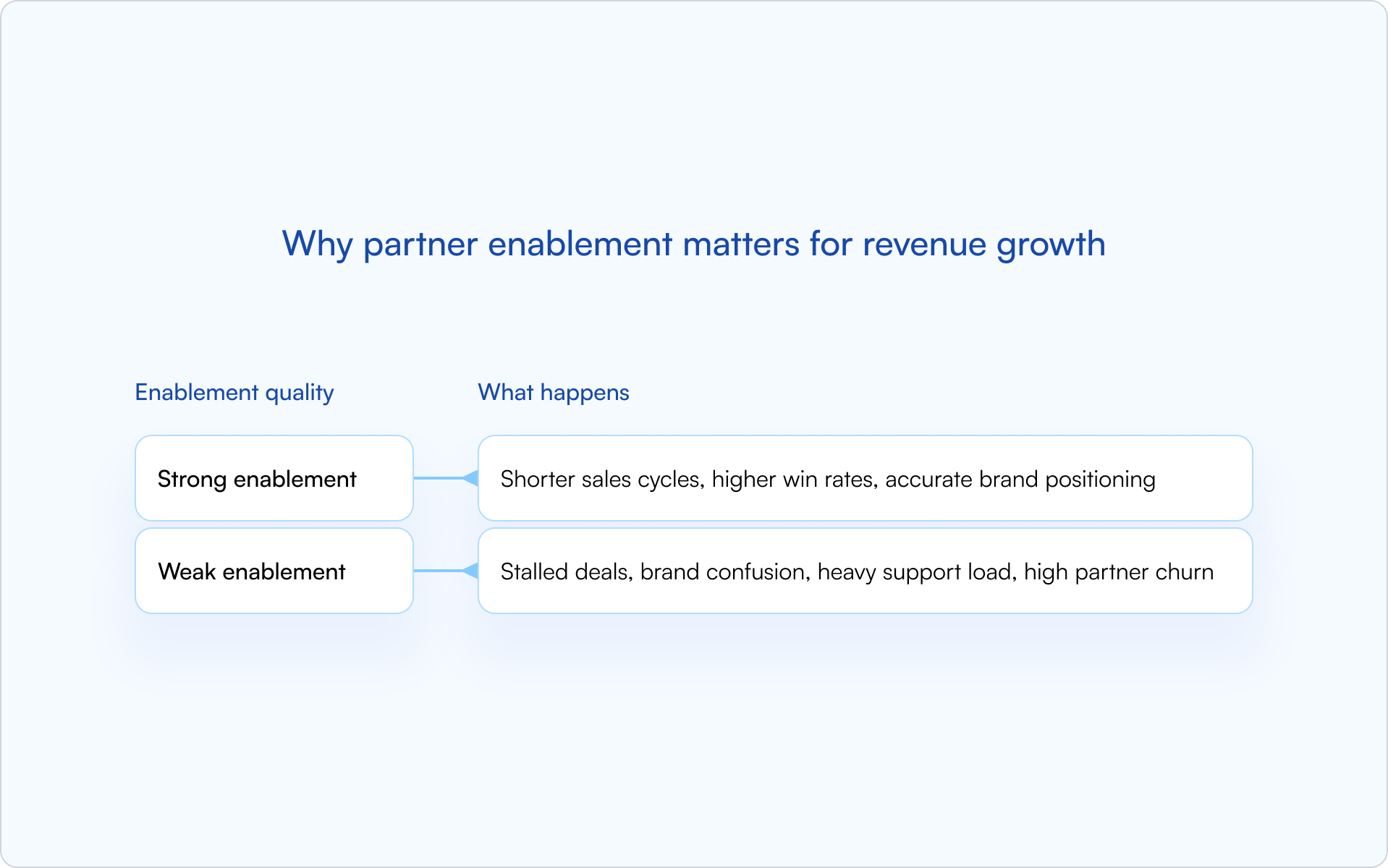
Why partner enablement matters for revenue growth

Enabled partners drive revenue because they can execute without friction. They close deals faster, represent your brand accurately, and generate pipeline you can actually attribute.

Weak enablement is expensive in quieter ways: partners misposition the product, opportunities stall, your team becomes the bottleneck, and high-potential partners churn because “it’s too hard to work with you.”

Enablement quality What happens
Strong enablement Shorter sales cycles, higher win rates, accurate brand positioning
Weak enablement Stalled deals, brand confusion, heavy support load, high partner churn

What a partner enablement program includes

A complete channel partner enablement program isn’t a portal full of PDFs. It’s a structured system that helps partners learn, launch, and improve — with clear ownership and measurable outcomes.

Partner training and certification

Training forms the foundation: product knowledge, competitive positioning, and your sales methodology. Certification acts as a gate, ensuring partners meet a minimum quality bar before they’re authorized to sell on your behalf.

Partner sales enablement

Partner sales enablement means giving partners the same caliber of sales tools your direct team uses, adapted to their role. Think: battle cards, demo scripts, objection-handling guides, and pricing documentation.

Marketing support and co-marketing

Effective enablement helps partners generate demand, not just close it. Co-branded assets, “campaign-in-a-box” kits, and structured lead-sharing programs all increase partner-sourced pipeline.

Partner portals (and why login friction kills adoption)

A partner portal should be a self-service hub for training, collateral, deal registration, and updates. But there’s a common failure mode: partners avoid portals that require a separate, inconvenient login.

CRM-first portals reduce that friction by connecting directly to HubSpot or Salesforce, so partners can work inside the flow of real deals instead of “checking another system.”

Performance tracking and ongoing communication

Enablement is ongoing, not a one-time launch. A strong program includes visibility into partner activity, a consistent communication cadence, and mechanisms for gathering feedback and improving the experience.

11 partner enablement best practices that drive results

If you’re building a partner program inside a startup, your constraint is almost never “ideas.” It’s focus and execution. These partner enablement best practices move from strategy through rollout and iteration — with an emphasis on what actually shows up in pipeline.

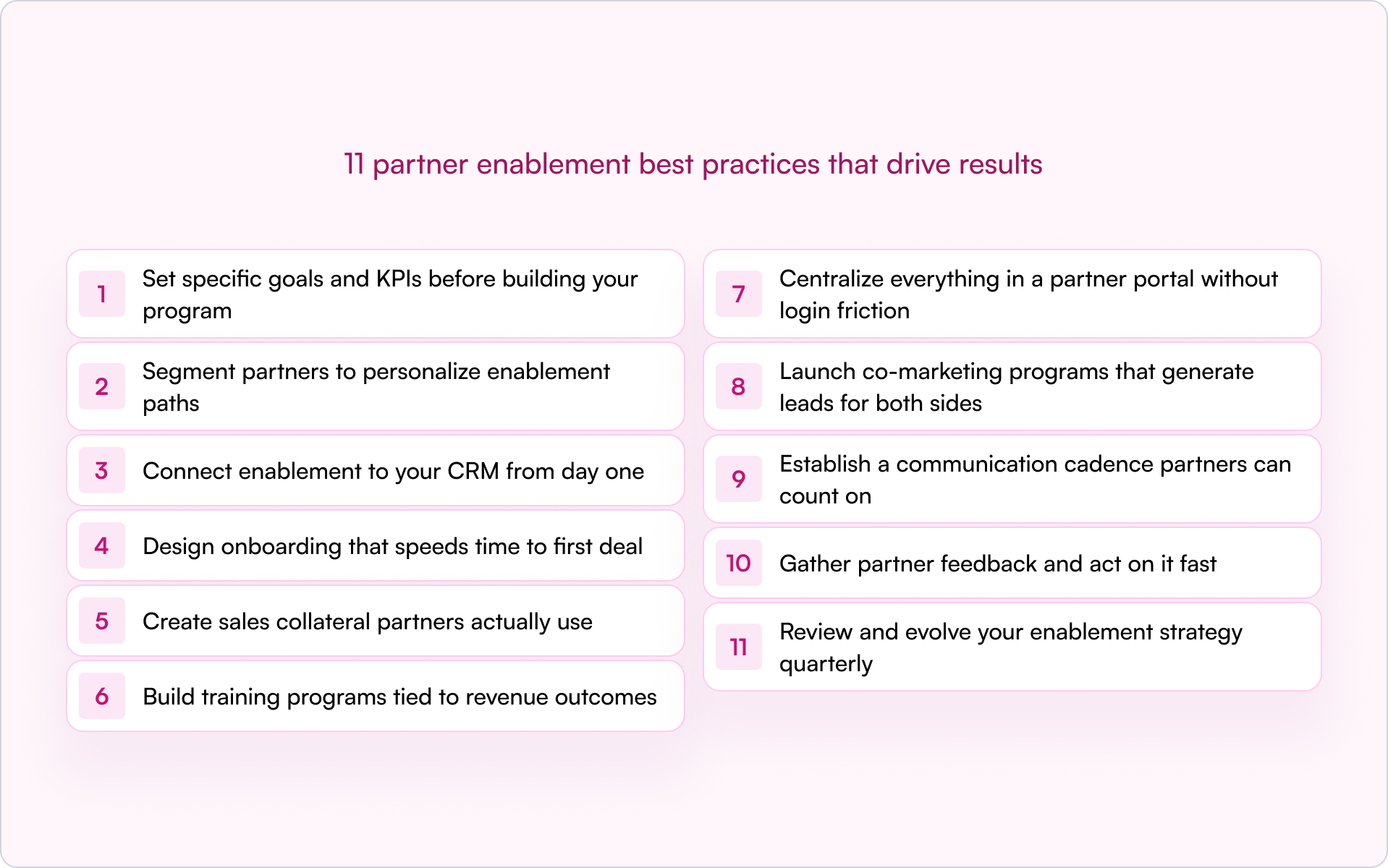
1. Set specific goals and KPIs before building your program

Before you create a single asset, define what success looks like. Start with outcomes — partner-sourced revenue targets, certification completion rates, and a target time-to-first-deal — then work backward into the program.

  • Partner-sourced pipeline value
  • Certification completion rate
  • Average time from onboarding to first registered deal
  • Content engagement (downloads, video views)

2. Segment partners to personalize enablement paths

Not all partners need the same materials. Segment by partner type (reseller, referral, systems integrator), vertical focus, or performance tier, then tailor training and content accordingly.

Segment Enablement focus
Resellers Deep product training, pricing, deal registration
Referral partners Lightweight pitch training, lead handoff process
SIs/MSPs Technical implementation guides, certification

3. Connect enablement to your CRM from day one

For true visibility and attribution, all your enablement data — certifications, content consumption, deal registrations — lives best in your CRM, not in a disconnected system.

A CRM-first approach provides a single source of truth. When partner activity syncs directly to HubSpot or Salesforce, your sales team and RevOps see the same reality. No more chasing updates or reconciling spreadsheets. (If deal attribution is a pain point today, it’s worth tightening up your workflow around partner deal registration specifically.)

4. Design onboarding that speeds time to first deal

Partner onboarding works best as a structured, time-bound journey — not a massive content dump. The goal is to get partners to their first real opportunity quickly, then reinforce with deeper training once momentum is real.

A strong onboarding checklist includes:

  • Welcome and program overview
  • Product and Ideal Customer Profile (ICP) training
  • Competitive positioning
  • Deal registration process walkthrough
  • First co-sell or shadow opportunity

5. Create sales collateral partners actually use

Don’t reinvent the wheel. Audit the sales collateral your direct team uses most effectively and adapt it for your partners. Prioritize assets that accelerate live deals: one-pagers, battle cards, ROI calculators, and customer stories.

The fastest way to avoid producing content no one opens is simple: ask partners what they need to win the deals they already have, then build for that.

6. Build training programs tied to revenue outcomes

Training works best when it’s modular, role-based, and tied to certification. Use certification as a gate — for example, require a partner to complete key modules before they can register deals or request MDF.

On-demand training offers flexibility; live sessions drive engagement for complex topics. Most teams land on a hybrid model.

7. Centralize everything in a partner portal without login friction

A partner portal should be the single place to find enablement content, register deals, and get program updates. But portals fail when they add friction — especially separate logins, stale content, and unclear navigation.

If you want adoption, reduce steps. Portals built directly on the CRM (with SSO or no-login options) make access feel seamless, which is often the difference between “partners love it” and “partners ignore it.”

8. Launch co-marketing programs that generate leads for both sides

Co-marketing goes beyond providing partners with your logo. Joint webinars, co-branded content like eBooks or case studies, and Market Development Funds (MDF) programs actively help partners generate demand.

If you’re a founder, this is one of the highest-leverage shifts you can make: partners often need help creating pipeline, not just closing it.

9. Establish a communication cadence partners can count on

Define a predictable rhythm. Partners shouldn’t have to guess where to find updates or whether deal registration is working. Use channels like email and Slack to reach partners where they already operate — don’t rely solely on them logging into a portal.

Frequency What to communicate
Weekly Deal registration status updates
Monthly Product updates, new content announcements
Quarterly QBRs, performance reviews, program changes

10. Gather partner feedback and act on it fast

Enablement is a two-way street. Collect feedback through surveys, QBR conversations, and portal analytics — then close the loop by making changes and telling partners what you changed.

Partners keep investing when they feel momentum. Small, fast improvements create that signal.

11. Review and evolve your enablement strategy quarterly

Partner enablement isn’t set-and-forget. Quarterly, review what’s working and what isn’t by analyzing content engagement, certification rates, and revenue impact. Then adjust your program like you’d adjust product — based on usage and outcomes.

Partner enablement training metrics to track

To understand if your partner enablement process is working, track metrics that connect enablement activities directly to revenue outcomes — not just vanity activities.

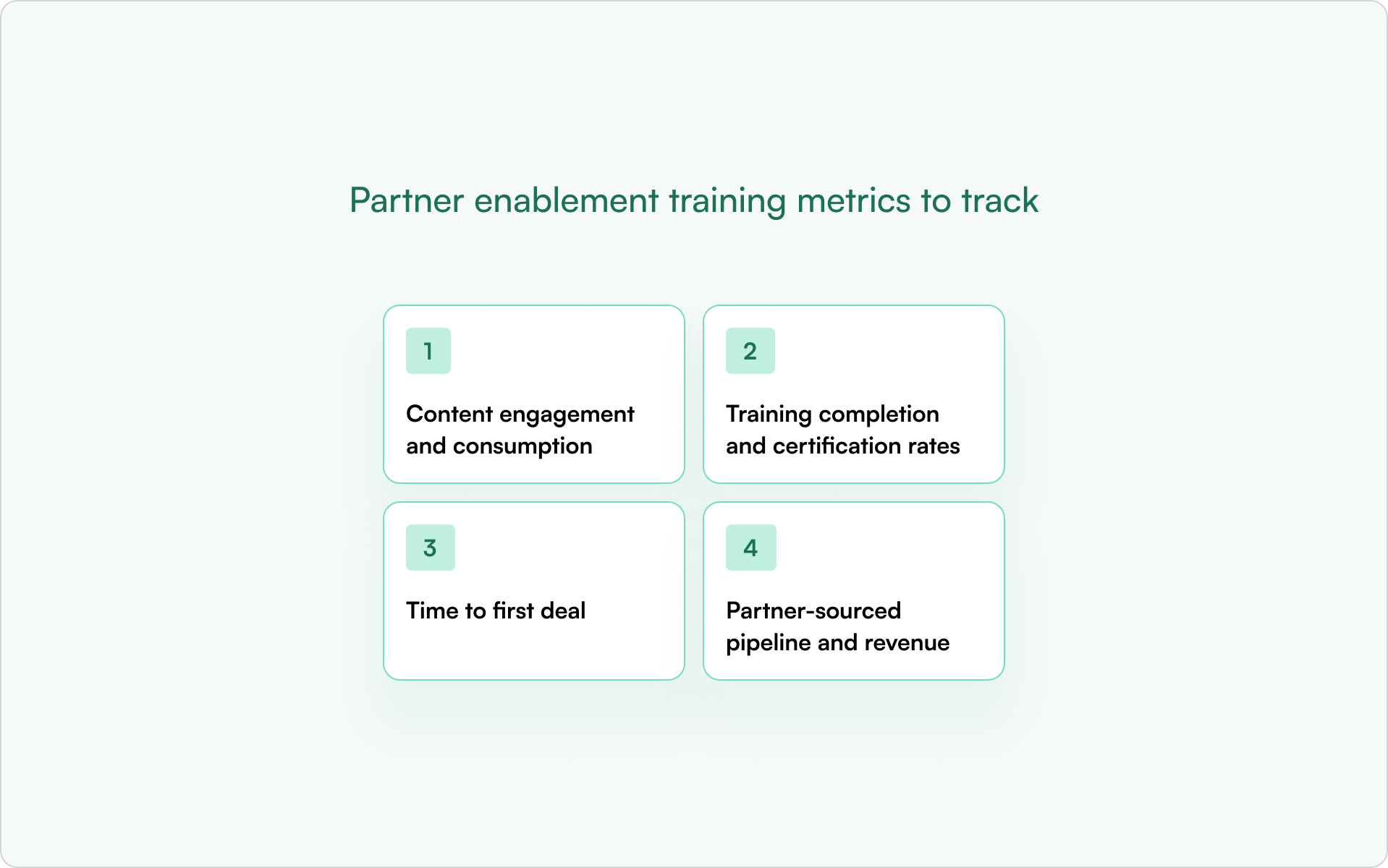
Content engagement and consumption

Track which resources partners actually use: downloads, video completion rates, and page views. Low engagement can signal the content isn’t relevant, is hard to find, or doesn’t match what partners need in active deals.

Training completion and certification rates

Measure how many partners complete onboarding and earn certifications. Completion rates help you pinpoint drop-off points so you can shorten, reorder, or redesign modules.

Time to first deal

Track the time between partner activation and their first registered deal. This is one of the cleanest indicators that onboarding is working — or that partners are stuck.

Partner-sourced pipeline and revenue

This is the ultimate scoreboard. Track pipeline and closed-won revenue generated by partners. To do it well, you need tight CRM attribution so enablement activity can be tied to financial results without manual cleanup.

How to automate your partner enablement process

Automation lets you scale partner enablement without scaling headcount. The goal isn’t to make the experience robotic — it’s to make it consistent, timely, and measurable.

CRM-based automation is ideal because it keeps data and workflows in one system. That’s how you avoid the “portal says one thing, CRM says another” problem.

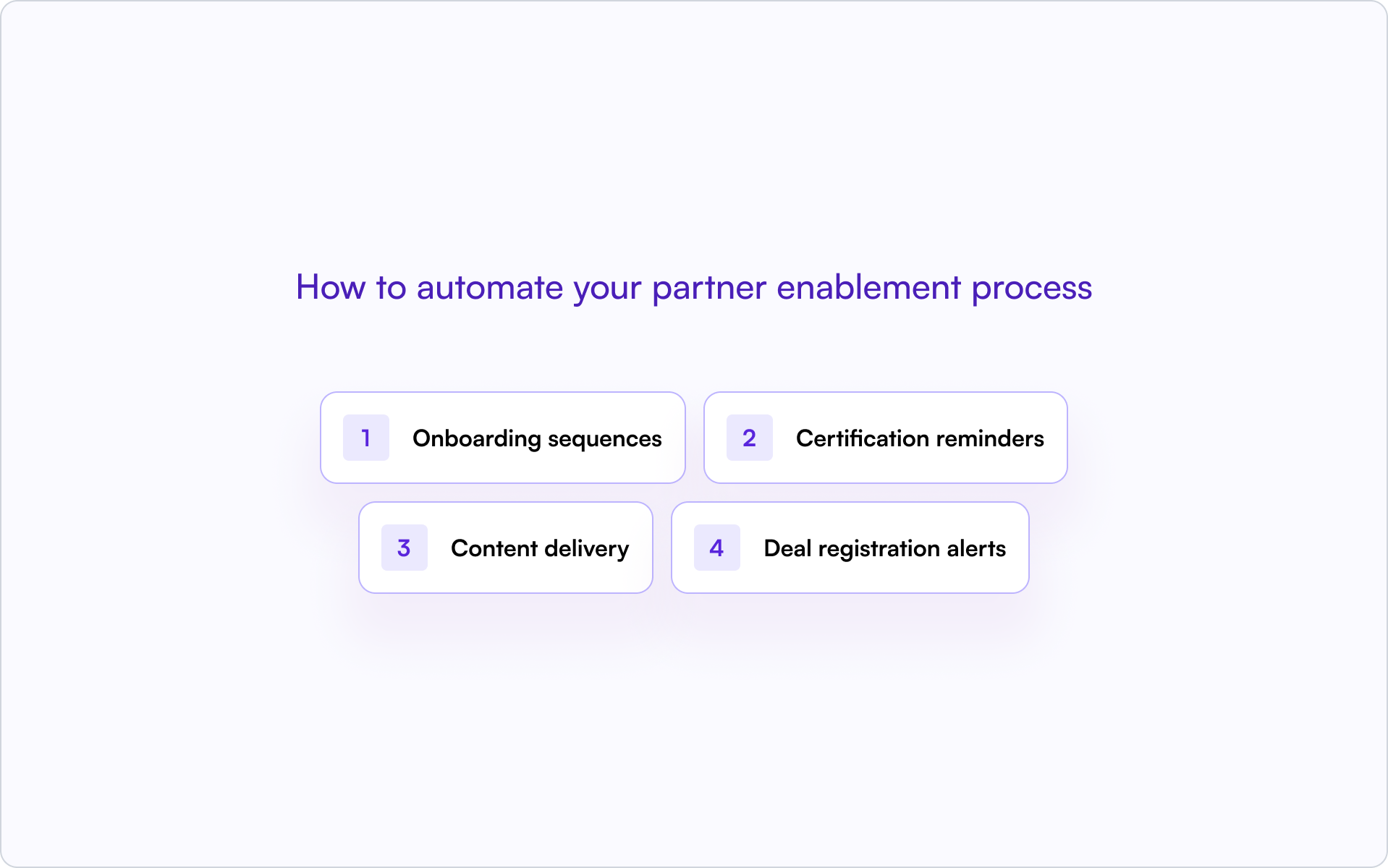
  • Onboarding sequences: Automatically enroll new partners in training modules and send welcome materials as soon as they sign up.
  • Certification reminders: Trigger automated alerts to partners and partner managers before certifications expire.
  • Content delivery: Push relevant collateral to partners based on their segment, tier, or deal stage.
  • Deal registration alerts: Automatically notify partners of the status of their registered deals.

Turn partner enablement into a revenue engine with Introw

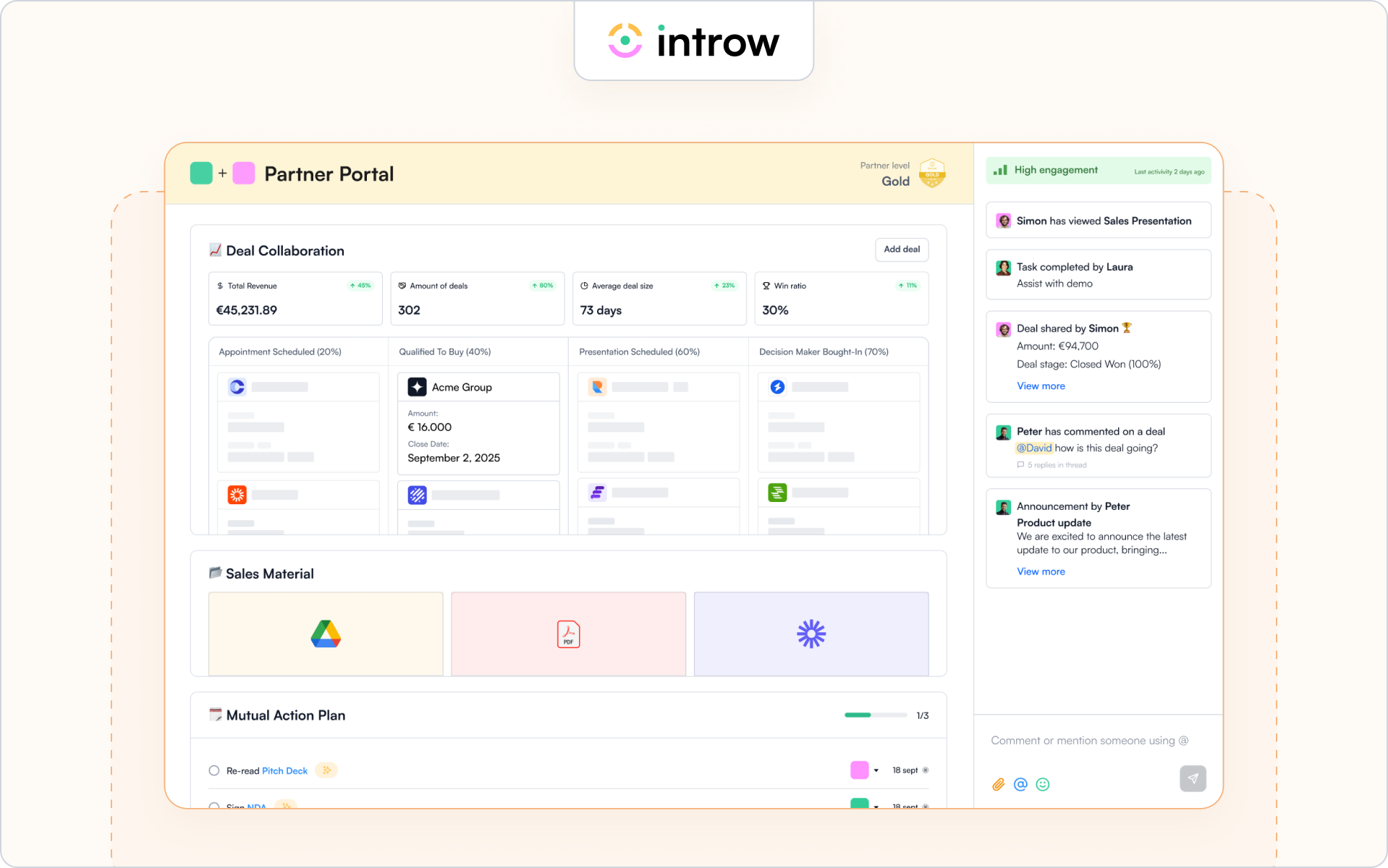
Introw is the CRM-first PRM that makes best-practice partner enablement practical and scalable. Because it’s built on HubSpot and Salesforce, Introw centralizes your entire partner program where you already work.

It includes a partner portal for centralizing enablement content without login friction, deal registration with real-time visibility, and off-portal collaboration so partners can reply via email while data syncs automatically to your CRM.

If you’re trying to get out of spreadsheet chaos and into measurable partner-sourced revenue, get a demo.

Conclusion

The best partner enablement programs aren’t built on more content — they’re built on clarity. Clear goals, segmented paths, CRM-connected workflows, and a focus on speed-to-first-deal turn “partners we signed” into “partners who ship revenue.”

Use these partner enablement best practices as a blueprint, then iterate quarterly based on what your data (and your partners) tell you.

Partner Management

11 Best Partner Engagement Platforms for SaaS Partner Programs

Janis De Sutter
Software Engineer
5 min. read
14 Mar 2026
⚡ TL;DR

The right partner engagement tools help your team activate partners faster, keep channel partner communication consistent, and turn partner activity into real pipeline. Modern partner engagement software goes beyond basic portals. It supports partner enablement, deal registration, and real-time collaboration with your sales team inside existing workflows. You'll get a shortlist of partner engagement platforms built for SaaS partner programs, plus what features actually matter when choosing one.

The 11 best partner engagement tools in 2026

The right partner engagement tools help your team activate partners, keep communication consistent, and connect partner activity to real pipeline.

Here is our shortlist of platforms used by SaaS companies to manage partner engagement, partner enablement, and channel partner collaboration.

1. Introw - Best CRM-native partner engagement platform

Introw is a CRM-first partner engagement platform built for SaaS companies that want partner engagement tied directly to pipeline activity.

Instead of forcing partners into a portal, Introw keeps partners up to date through email, Slack, and CRM-driven workflows while logging partner activities directly inside HubSpot or Salesforce.

Because engagement data connects to deals and revenue, your team can clearly see how partner engagement influences partner performance and sales performance. This is why many SaaS companies adopt a CRM-native approach to partner engagement rather than relying on standalone partner portals.

Teams often use Introw to manage partner communication, deal registration, partner onboarding, and channel partner enablement directly inside their CRM. Many of the workflows behind these processes are documented in Introw’s resources on partner engagement.

Best for

SaaS companies that want partner engagement tied directly to pipeline and CRM workflows.

Key engagement features

  • CRM-native collaboration inside HubSpot and Salesforce
  • Segmented announcements to keep partners up to date
  • Engagement tracking and performance analytics
  • Off-portal communication logging across email and Slack
  • Deal registration and deal-based partner activity visibility
  • Engagement metrics connected to partner performance and revenue
  • Integrated partner portal and partner training capabilities for channel partner enablement programs

Strength

Deep CRM integration allows partner engagement data to live alongside deals, accounts, and sales process activity, making it easier for RevOps and the sales team to monitor partner activities and optimize channel partner performance.

Limitation

Companies without Salesforce or HubSpot will not benefit from the platform’s CRM-native design.

Ideal company size

Mid-market and enterprise SaaS companies running structured partner programs with multiple partner managers and active partner ecosystems.

A strong partner engagement platform should make it easier to activate partners and track their impact on the pipeline. Now let’s look at other tools used across partner ecosystems and channel partner enablement programs.

2. Impartner – Enterprise partner management platform

Impartner is a partner management platform designed for companies running large channel partner ecosystems. It focuses on structured partner onboarding, partner marketing, and automation that helps partner programs scale while keeping partners up to date.

Best for

Enterprise companies managing complex channel partner ecosystems and structured channel partner enablement programs.

Key engagement features

  • Automated partner onboarding and partner training workflows
  • Campaign management and marketing materials for partner marketing
  • Performance analytics dashboards to monitor partner performance

Strength

Strong structure for large partner ecosystems that need standardized workflows across partner onboarding, partner enablement, and partner management.

Limitation

Engagement often depends on partners returning to a portal, which can slow down real-time partner activities and collaboration with the sales team.

Ideal company size

Enterprise organizations with global partner programs and large partner networks.

3. Channelscaler – Partner enablement and automation platform

Channelscaler is a partner platform designed to help companies scale partner revenue through PRM, partner program automation, and channel partner enablement. It focuses on partner onboarding, training, content delivery, and structured program management across partner ecosystems. 

Best for

Companies that want structured partner onboarding, partner enablement, and channel partner enablement tools in one platform.

Key engagement features

  • Partner onboarding, training, and personalized learning paths
  • Content delivery for marketing resources and marketing materials
  • Program automation and reporting to monitor partner performance

Strength

Strong fit for teams that need structured channel partner enablement and formal partner program workflows across a growing partner network. 

Limitation

The platform is more program- and portal-led than lightweight, CRM-native engagement, so it may feel heavier for teams that want faster off-platform collaboration. This is an inference from its public positioning and feature structure. 

Ideal company size

Mid-market and enterprise companies running structured partner programs. 

4. Channeltivity – Practical PRM for growing channel teams

Channeltivity is PRM software built for companies that want practical partner management without heavy enterprise complexity. It supports partner onboarding, partner marketing coordination, and deal registration workflows across growing partner ecosystems.

Teams often use the platform to monitor partner activities, track channel partner performance, and keep partners up to date on sales strategies and partner initiatives.

Best for

Mid-market companies building structured partner programs and growing channel partner ecosystems.

Key engagement features

  • Deal registration, referral tracking, and lead generation workflows
  • Built-in communication tools to keep partners up to date
  • Reporting dashboards that track partner performance and sales performance

Strength

Clear operational structure for partner activities and partner onboarding across growing partner networks.

Limitation

The platform focuses on partner management processes rather than deeper engagement analytics tied directly to pipeline.

Ideal company size

Mid-market organizations with developing partner ecosystems and growing channel partner programs.

5. PartnerStack – Ecosystem platform for affiliate and referral programs

PartnerStack is an ecosystem platform used by SaaS companies to recruit, manage, and reward partners across affiliate, referral, and reseller partner programs. It helps companies scale their market reach by managing partner incentives and partner performance at scale.

Many SaaS companies rely on PartnerStack to support lead generation and expand their partner network while rewarding partner productivity.

Best for

SaaS companies running affiliate, referral, or partner-led growth programs.

Key engagement features

  • Automated partner onboarding and partner incentives management
  • Commission tracking and reward partners workflows
  • Performance analytics dashboards that track partner productivity

Strength

Strong ecosystem platform for scaling partner programs and expanding market reach.

Limitation

The platform focuses primarily on affiliate-style programs rather than deep co-selling workflows tied to CRM sales process activity.

Ideal company size

Small to mid-market SaaS companies scaling partner ecosystems and referral programs.

6. Unifyr – Enterprise ecosystem management platform

Unifyr is an ecosystem management platform designed to help enterprise companies coordinate partner engagement, partner marketing, and partner enablement across complex partner ecosystems.

It supports structured partner programs with automation, analytics, and tools designed to optimize channel performance across large partner networks.

Companies running global channel programs often use the platform to strengthen relationships with partners and monitor channel partner performance across multiple regions.

Best for

Enterprise companies managing complex global partner ecosystems.

Key engagement features

  • Multi-portal partner engagement and partner management capabilities
  • Campaign management and marketing resources for partner marketing
  • Performance analytics that track channel partner performance

Strength

Enterprise-grade ecosystem management with strong reporting and partner marketing capabilities.

Limitation

The platform is designed for large enterprise ecosystems and may be too complex for smaller partner programs.

Ideal company size

Enterprise organizations managing large partner ecosystems and global channel partner networks.

7. Magentrix – Partner portal and collaboration platform

Magentrix is a partner portal platform built on Salesforce that helps companies manage partner onboarding, partner communication, and collaboration across partner ecosystems. It focuses on centralizing partner engagement, marketing resources, and communication tools inside a secure partner portal.

Best for

Companies running Salesforce that want structured partner portals to support channel partner enablement.

Key engagement features

  • Partner portal collaboration and communication tools
  • Content hubs for marketing materials and partner marketing
  • Activity tracking to monitor partner activities and partner performance

Strength

Tight Salesforce integration helps the sales team monitor partner activities and support channel partner performance across deals.

Limitation

Engagement often depends on partners logging into the portal rather than collaborating through external communication channels.

Ideal company size

Mid-market and enterprise companies managing partner ecosystems on Salesforce.

8. Kiflo PRM – Lightweight partner management platform

Kiflo PRM is a partner management platform designed for SaaS companies building structured partner programs. The platform focuses on partner onboarding, deal registration, and partner engagement across growing partner networks.

It helps partner managers monitor partner activities and coordinate partner enablement programs without the complexity of heavier enterprise PRM systems.

Best for

SaaS companies launching or scaling channel partner programs.

Key engagement features

  • Partner onboarding workflows and partner tiers management
  • Deal registration and pipeline collaboration with the sales team
  • Reporting dashboards to track partner productivity and partner performance

Strength

Lightweight partner management system that helps smaller teams organize partner activities and improve partner productivity.

Limitation

The platform is simpler than enterprise partner engagement tools and may lack deeper ecosystem automation for very large partner programs.

Ideal company size

Small to mid-market SaaS companies building early partner ecosystems.

9. WorkSpan – Ecosystem collaboration platform

WorkSpan is an ecosystem management platform designed to help companies coordinate partnerships, co-sell motions, and joint sales strategies across partner ecosystems. It focuses on collaboration between companies rather than traditional PRM portals.

The platform helps revenue teams monitor partner activities and connect partner engagement to shared business objectives.

Best for

Enterprise companies running strategic alliances, co-sell partnerships, and ecosystem programs.

Key engagement features

  • Joint pipeline tracking and opportunity collaboration
  • Ecosystem reporting and performance analytics
  • Shared workspaces to coordinate partner activities

Strength

Strong platform for companies that want to optimize channel performance across strategic alliances and joint sales initiatives.

Limitation

It focuses more on ecosystem collaboration than traditional partner onboarding or partner enablement workflows.

Ideal company size

Enterprise companies managing strategic partner ecosystems and alliances.

10. Mindmatrix – Partner enablement and marketing platform

Mindmatrix is a partner enablement platform designed to help companies manage partner marketing, partner training, and partner engagement across global partner networks.

The platform combines partner enablement tools with marketing automation and sales content management to help partners stay aligned with company sales strategies.

Best for

Companies that want to support partner marketing and channel partner enablement at scale.

Key engagement features

  • Marketing automation and marketing resources for partners
  • Training modules with tailored training programs
  • Incentive management and engagement analytics for partner performance

Strength

Strong support for partner marketing and marketing materials that help motivate partners and strengthen relationships.

Limitation

The platform focuses heavily on marketing automation rather than direct CRM collaboration with the sales process.

Ideal company size

Mid-market and enterprise companies managing global partner programs.

11. Salesforce PRM – Native partner management inside Salesforce

Salesforce PRM is Salesforce’s native partner relationship management solution built within Experience Cloud. It allows companies to manage partner onboarding, partner engagement, and deal collaboration directly inside the Salesforce ecosystem.

Because partner activities are connected to CRM data, revenue teams can monitor channel partner performance and track how partner engagement influences sales performance.

Best for

Organizations already running Salesforce that want partner management built directly into their CRM.

Key engagement features

  • Deal registration and pipeline collaboration with the sales team
  • Partner portals with content libraries and communication tools
  • Reporting dashboards that track partner performance and partner satisfaction

Strength

Native CRM integration allows partner activities to connect directly to pipeline and sales performance.

Limitation

Setup and customization can require significant Salesforce administration and technical resources.

Ideal company size

Mid-market and enterprise companies operating primarily within Salesforce ecosystems.

These platforms show the different ways companies approach partner engagement. Some focus on portals and partner management. Others focus on ecosystem collaboration or partner marketing automation.

The right choice depends on how your team activates partners, supports the sales process, and monitors partner performance across your partner network.

Next, let’s look at the specific capabilities that matter most when comparing partner engagement tools.

What to compare in partner engagement tools

Once you’ve shortlisted a few partner engagement tools, the next step is evaluating how they support real partner engagement across your partner network.

The right platform should help you monitor partner activities, keep partners up to date, and connect engagement to pipeline.

Most modern partner engagement tools also act as a centralized platform that aligns partner work with the sales process.

Here are the capabilities revenue teams compare when evaluating partner engagement platforms.

1. CRM-native collaboration

Many partner engagement tools still operate outside the CRM. That makes it harder for the sales team to see partner activities during the sales process.

Look for platforms that allow partner collaboration directly around deals.

Check whether the tool can:

  • Log partner activities inside Salesforce or HubSpot
  • Support deal registration and opportunity collaboration
  • Capture email or Slack conversations tied to deals
  • Give the sales team visibility into partner engagement

CRM visibility helps teams connect partner engagement to sales performance and optimize channel performance across partner ecosystems.

Teams building structured partner programs often pair CRM collaboration with clear partner lifecycle management so engagement aligns with pipeline development.

Next, let’s look at communication capabilities.

2. Segmented announcements and messaging

Generic announcements rarely motivate partners.

Modern partner engagement tools allow partner managers to target messages based on partner tiers, market reach, or product focus.

Look for platforms that support:

  • Segmentation by partner tiers or partner programs
  • Targeted updates that keep partners up to date
  • Communication tools that track responses and engagement

Clear messaging helps improve partner productivity and maintain alignment across B2B SaaS partnerships and partner ecosystems.

Once communication improves, the next step is measuring impact.

3. Engagement analytics and revenue visibility

Partner engagement should connect to measurable outcomes.

Strong platforms provide analytics that help teams monitor partner activities and understand how engagement affects revenue.

Look for reporting that shows:

  • Active partners across your partner network
  • Campaign participation and engagement trends
  • Partner productivity and sales performance
  • Revenue influenced by engaged partners

These insights help teams optimize channel performance and reward partners who contribute to the pipeline. Many programs support this with structured partner performance incentives.

Next, consider how tools support collaboration outside portals.

4. Off-portal engagement capabilities

Many partners stop logging into portals after partner onboarding.

Partner engagement tools should support collaboration outside the portal while still tracking engagement.

Look for tools that allow partners to:

  • Respond to messages via email
  • Collaborate through communication tools like Slack
  • Join deal discussions without logging into a portal
  • Sync conversations back to the CRM

This improves partner experience and helps partner managers maintain consistent engagement across partner ecosystems.

Finally, automation helps scale engagement.

5. Workflow automation

As partner ecosystems grow, manual partner management becomes difficult.

Partner engagement tools should automate repetitive partner activities so partner managers can focus on strategy.

Look for automation features such as:

  • Deal follow-ups tied to the sales process
  • Reactivation campaigns for inactive partners
  • Partner tier progression triggers
  • Incentive management to reward partners

Automation improves partner productivity and helps maintain consistent partner engagement across channel partner enablement programs.

Next, let’s look at how Introw approaches partner engagement at the execution layer.

How Introw powers partner engagement (execution layer)

Most partner engagement tools rely on portals.

But if engagement data never reaches the CRM, revenue teams lose visibility into how partners actually influence pipeline.

Introw is designed to solve partner engagement around deals, conversations, and partner activities that move the sales process forward.

Instead of managing partner engagement in a separate system, Introw connects partner communication, collaboration, and engagement insights directly to HubSpot and Salesforce.

Introw acts as a centralized platform where partner engagement, deal collaboration, and revenue visibility live together.

CRM-native collaboration

Partner engagement should happen where opportunities live.

Introw allows partner managers and the sales team to collaborate with partners directly around deals inside the CRM. Partner activities stay tied to accounts, opportunities, and the broader sales process.

Teams can:

  • Track partner engagement alongside deals and pipeline
  • Collaborate with partners during deal registration and opportunity development
  • Monitor partner productivity and partner performance across partner programs

Because engagement happens inside the CRM, revenue teams can finally connect partner engagement to sales performance.

Announcements and partner segmentation

Keeping partners up to date across partner ecosystems is harder than it sounds.

Introw allows partner managers to send segmented announcements based on partner tiers, region, or product specialization. This helps channel teams communicate relevant updates without overwhelming the partner network.

Announcements often support:

  • Product updates and sales strategies
  • Channel partner enablement program updates
  • Partner marketing initiatives and marketing resources
  • Partner training and tailored training programs

Targeted communication helps partner managers motivate partners and strengthen relationships across partner ecosystems.

Off-portal engagement

Many partners stop logging into portals after partner onboarding.

Introw supports off-portal engagement so partners can respond through email or Slack while engagement data still syncs back to the CRM.

This allows teams to:

  • Monitor partner activities without forcing portal logins
  • Keep partners up to date through familiar communication tools
  • Capture conversations tied to opportunities and deal progress

If you would like to explore the feature set in more detail, the resources on partner engagement explain how announcements, engagement insights, and communication workflows work inside the platform.

Engagement insights and revenue visibility

Partner engagement should lead to measurable outcomes.

Introw gives revenue teams visibility into how partner engagement affects channel partner performance across the pipeline.

Teams can track:

  • Active partners across the partner network
  • Engagement trends across partner ecosystems
  • Partner productivity tied to deals and revenue
  • How engagement supports lead generation and market reach

This makes it easier to optimize channel performance and reward partners who contribute to real business outcomes.

If you’re evaluating partner engagement tools, start by asking a few practical questions:

  1. Can we see partner engagement directly inside our CRM and sales process?
  2. Do we have visibility into partner activities and partner performance across our partner network?
  3. Can we keep partners up to date without relying on a portal?
  4. Are we measuring engagement in ways that actually improve channel partner performance?

If the answer to those questions is unclear, it may be time to rethink how partner engagement works in your partner programs.

Over to you

You can request a demo to see how Introw connects partner engagement, CRM collaboration, and revenue visibility in one place.